Which Manjha Is Best for Kite Fighting? The Honest Answer Is None.
If "manjha" means coated fighting string — and in this question it always does — the answer is that no manjha is best, because every coated, glass, chemical or metallic line is banned in Punjab, carries three to five years' imprisonment and up to Rs. 2 million in fines, and is the direct reason seventeen families buried someone after Basant 2026's road and wire accidents across the years of illegal string. The legal question with a real answer is: which cotton pinna fights best — and that comes down to premium names, fresh winding, and hands that know a pecha.
- Every "best manjha" candidate — chemical, glass, nylon, metallic — is criminal to make, sell or use
- The penalty is the framework's heaviest, and the offence has been reported non-bailable
- Coated line doesn't make you a better fighter; it makes you a liability with a charkhi
- Cotton duels are won by line quality, kite control and technique — the skill the festival was built on
- The legal "best": premium 9-ply names, consistent winding, matched to a kite you fully control
We sell kite string for a living, and we're going to answer this search honestly instead of profitably: if you're asking which manjha is best for fighting, you're one purchase away from the only mistake this festival cannot absorb. Here's why the question has no legal answer, what happened the last time the city answered it anyway — and then the question worth asking instead, answered properly.
Why is there no "best manjha"?
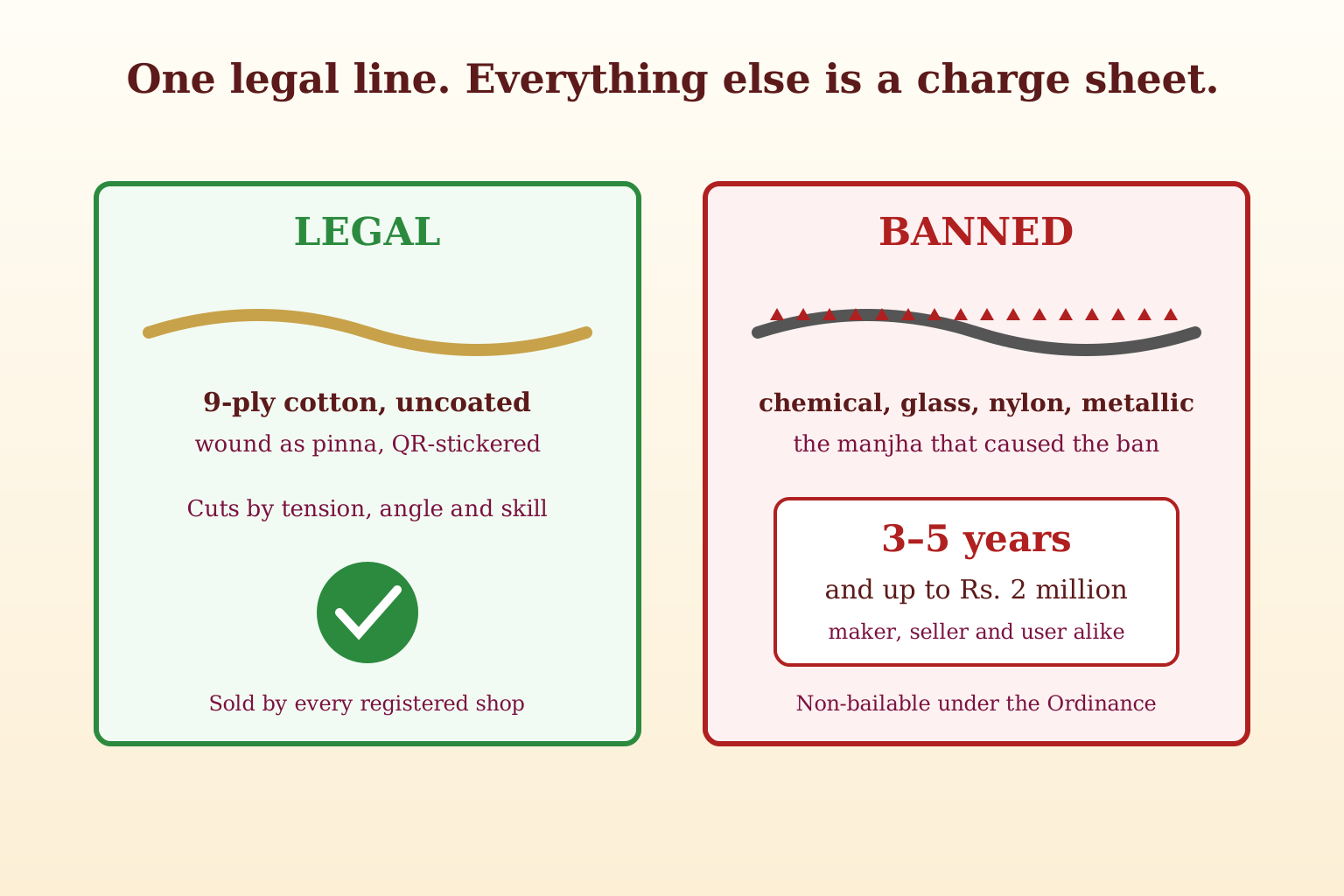
Because the category is criminal, not because the shops are timid. Punjab's framework bans coated fighting string entirely — metallic wire, nylon, glass- and chemical-coated manjha — with three to five years' imprisonment, fines to Rs. 2 million, or both, reaching maker, seller and user alike. There is no licensed version, no tournament exemption, no "just for the final day".
The law is this absolute because the history was: coated line is what cut throats at road height and killed through the ban years, and it remains the one product that could end the revived festival for the whole city. The full ban-history timeline is eighteen years of evidence for one sentence: the festival lives exactly as long as this string stays gone.
Doesn't coated line win duels, though?
It wins pechas and loses everything else. Yes — abrasive line cuts cotton; that asymmetry is the entire temptation. Now the full ledger: it cuts *hands* (yours, your family's), it cuts *bystanders* at street level where every lost line eventually lands, metallic variants find power infrastructure, and one scan-and-search at a checkpoint converts your festival into a criminal case.
And here's the part duelling pride should actually care about: among flyers, winning on coated line has always been the counterfeit victory. The festival's whole competitive tradition — the reason bo kata means something — grew on skill against skill, cotton against cotton. Buying cuts you can't earn is the rooftop equivalent of arm-wrestling with a machine.
What's the real answer — which legal string fights best?
Now there's a question with substance. In an all-cotton sky, three factors decide pechas:
- Line quality within the legal spec. Premium names earn their ladder position on consistency — even winding, true 9-ply glace thread, piece after piece behaving identically. That predictability is duel equipment: 8 Chain and Air Blade top our shelf for exactly this reason.
- Freshness and handling. New, well-stored cotton bites better than last season's sun-tired ball; smooth pay-off from a good charkhi keeps tension live through the fight.
- The flyer. Angle, timing, tension control — the pecha is won in the wrist, and the technique tradition transfers entirely through practice.
That's the honest hierarchy: hands, then winding, then name — all of it legal, all of it earnable.
How do you refuse the offer politely?
Because you will get one — a whispered "asli maal" near festival week is a Lahore constant. The refusal that works is boring: *"Cotton only — the roof isn't worth a case."* No lecture needed; the seller knows the law better than you do. If the offer is persistent or industrial-scale, festival seasons run dedicated police control rooms for exactly this reporting.
Frequently asked questions
Which manjha is best for kite fighting in Pakistan?
None — every coated fighting string is banned with severe criminal penalties. The legal best is premium 9-ply cotton pinna in skilled hands.
Is there any legal manjha?
If manjha means coated string: no. The legal category is plain thread-based cotton — pinna — and it's the only line any registered shop will sell you.
Can cotton dor cut another kite?
Yes — cotton-on-cotton pechas are the festival's original sport. Cuts come from tension, angle and line quality; that's the game.
What happens if police find chemical manjha?
Confiscation is the floor; prosecution under the Ordinance's heaviest provisions is the exposure — for possession in use, not just sale.
What string do serious duellists actually buy from you?
The premium end of the shelf — 8 Chain and Air Blade, typically in 4-piece balls — paired with kites they fully control. Skill spends money where it compounds.
Win it the way it counts
March's sky will be full of flyers who chose the counterfeit shortcut's opposite: good cotton, good hands, real bo katas. Join that side of the festival — the legal shelf is here, reservable free or price-locked — and let every cut you take this season be one you earned.
Written by M/S SpeedX Kites, a registered kite seller in Lahore (Reg No. 38731-28012026). If anything here is out of date or wrong, tell us on WhatsApp and we will correct it.
More on rules & safety

Is kite flying legal in Pakistan right now? The province-by-province answer
It depends on the province and the date. In Punjab, kite flying is legal only during the government's announced festival window and under the 2025 Ordinance's conditions — outside that window it remains prohibited, including in Lahore. In Sindh, kite flying, manufacture and sale are banned outright. Status as of late August 2026: no flying window is open anywhere in Pakistan; the next announced window is Basant 2027, 12–14 March in Lahore.
Kite Flying Punishment in Pakistan: The Actual Fines and Jail Terms, Offence by Offence
The heaviest kite-related punishment in Pakistan targets banned string: making, selling or using metallic wire, nylon or chemical/glass-coated manjha carries three to five years' imprisonment, a fine up to Rs. 2 million, or both, under Punjab's 2025 Ordinance. Flying outside the announced window, selling without registration, and rooftop conduct violations are separate offences with their own consequences — and in Sindh, all kite flying is banned outright.