When Was Kite Flying Banned in Punjab? The Full Timeline, Including the False Starts
In stages: Punjab first imposed kite-flying regulations in 2005 after years of string deaths, and the full provincial ban took effect in 2007. Brief court-ordered or government relaxations in the late 2000s ended after fresh casualties, and the ban then held largely unbroken until the Punjab Regulation of Kite Flying Ordinance 2025 enabled the legal revival of 6–8 February 2026.
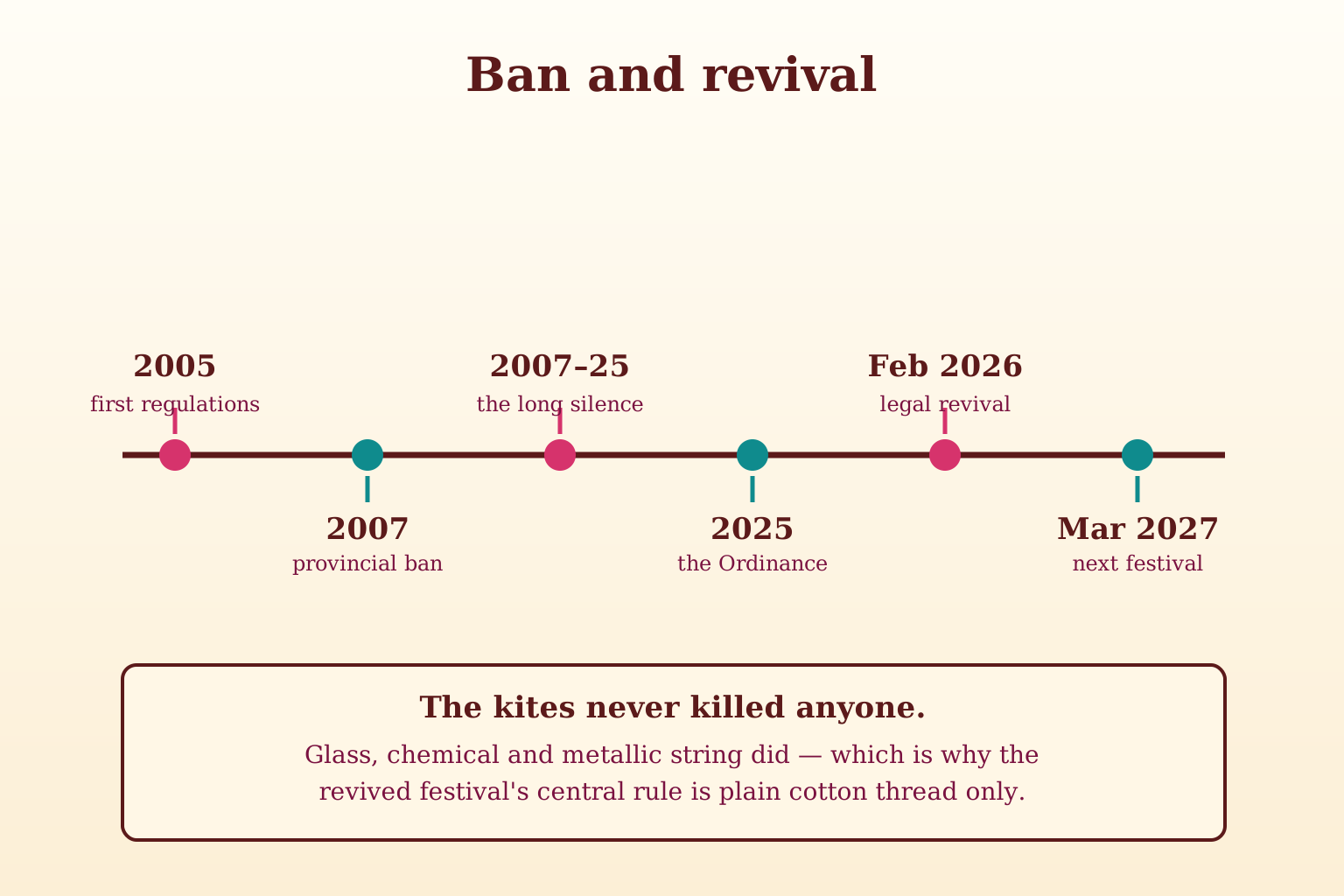
- 2005: first regulations restricting kite flying, after dozens of deaths in preceding seasons
- 2007: the provincial ban takes effect — the date most "since when?" answers point to
- Late 2000s: short-lived relaxations end in renewed casualties and mass arrests
- 2005–2025: an entire generation grows up without a legal Basant
- 2025–26: the Ordinance rebuilds the festival on licences and traceability; Lahore flies legally again
Ask when kite flying was banned in Punjab and you'll hear both 2005 and 2007 — and both have a claim, which is why this timeline exists. The ban wasn't a single stroke of a pen; it was an escalation, punctuated by attempts to bring the festival back that ended badly. Knowing the sequence explains why the 2026 revival was designed the way it was — and why, as sellers inside the revived system, we treat its rules as non-negotiable.
Did the ban start in 2005 or 2007?
Both dates mark real steps. Kite-flying regulations were first put in place in 2005, and the provincial ban on Basant took effect in 2007 — so "regulated from 2005, banned from 2007" is the accurate one-line answer. The pressure behind both was the same: in the years leading up to the ban, dozens of people were killed during festival seasons, overwhelmingly by strings coated with glass, chemicals or metal.
The kite itself was never the offence; the weaponised line was. That distinction runs through every subsequent chapter.
Why did the relaxations fail?
Because each time the sky reopened, the illegal string came back with it. In one two-week relaxation, Lahore's flyers returned in force — and so did casualties and chaos, ending the experiment. Enforcement in the ban years was genuinely heavy: one crackdown saw over 3,700 people arrested across Punjab, and hundreds defied the ban anyway, keeping the cat-and-mouse alive for years.
The lesson the state eventually drew: an on/off ban couldn't separate the festival from the string trade that poisoned it. Only a system that could trace every kite and criminalise every coated line stood a chance.
What changed in 2025?
The approach. The Punjab Regulation of Kite Flying Ordinance 2025 didn't simply lift the ban — it replaced prohibition with infrastructure: manufacturing confined to four licensed districts, registered sellers, QR stickers resolving every kite to its maker, cotton-only string with criminal penalties up to five years and Rs. 2 million for the banned kinds, adult-only flying, and festival windows announced by government.
On that foundation, Lahore celebrated its first legal Basant in eighteen years on 6–8 February 2026 — a revival whose own hard lessons (seventeen deaths, mostly rooftop falls) then produced the stricter rooftop framework now arriving for 2027.
The timeline at a glance
| Year | What happened |
|---|---|
| pre-2005 | String deaths mount through the festival's biggest seasons |
| 2005 | First provincial regulations restrict kite flying |
| 2007 | The full ban takes effect |
| late 2000s | Short relaxations end after fresh casualties; mass-arrest enforcement |
| 2007–2025 | The long silence — no legal Basant for a generation |
| 2025 | The Ordinance creates the licence-and-traceability framework |
| Feb 2026 | The legal revival: 6–8 February, Lahore |
| Dec 2026 | New rooftop-safety rules take effect for the next season |
| Mar 2027 | Basant 2027, announced for 12–14 March |
Frequently asked questions
How long was kite flying banned in Punjab?
Effectively eighteen years — from the 2007 ban to the February 2026 revival, with only brief, failed relaxations in between.
Why do some sources say 20 years?
Round numbers and different starting points: counting from the 2005 regulations, or from the last "normal" festivals before them, stretches the figure. The sourced anchors are 2005 (regulations), 2007 (ban), 2026 (revival).
Was Basant banned all over Pakistan?
The famous ban was Punjab's. Sindh maintains its own outright prohibition to this day, which is why the revived festival exists only under Punjab's framework.
Who banned kite flying in Punjab?
The provincial government, escalating from regulation to ban as string deaths continued — with courts involved at several points, including in the revival era's oversight.
Could kite flying be banned again?
The revival explicitly survives on its safety record, and the festival remains under court scrutiny after 2026. That's the strongest argument this page can make for flying strictly by the rules.
Eighteen years is long enough
The ban's history is the best argument for the legal festival: verified kites and cotton line are what stand between Lahore and another silence. We stock only that — browse and reserve for March, free or price-locked, and be part of the version of Basant that gets to keep happening.
Written by M/S SpeedX Kites, a registered kite seller in Lahore (Reg No. 38731-28012026). If anything here is out of date or wrong, tell us on WhatsApp and we will correct it.
More on rules & safety
Is kite flying legal in Pakistan right now? The province-by-province answer
It depends on the province and the date. In Punjab, kite flying is legal only during the government's announced festival window and under the 2025 Ordinance's conditions — outside that window it remains prohibited, including in Lahore. In Sindh, kite flying, manufacture and sale are banned outright. Status as of late August 2026: no flying window is open anywhere in Pakistan; the next announced window is Basant 2027, 12–14 March in Lahore.
Kite Flying Punishment in Pakistan: The Actual Fines and Jail Terms, Offence by Offence
The heaviest kite-related punishment in Pakistan targets banned string: making, selling or using metallic wire, nylon or chemical/glass-coated manjha carries three to five years' imprisonment, a fine up to Rs. 2 million, or both, under Punjab's 2025 Ordinance. Flying outside the announced window, selling without registration, and rooftop conduct violations are separate offences with their own consequences — and in Sindh, all kite flying is banned outright.