Minimum Wind for Kite Flying — and What Lahore's Sky Gives You, Month by Month
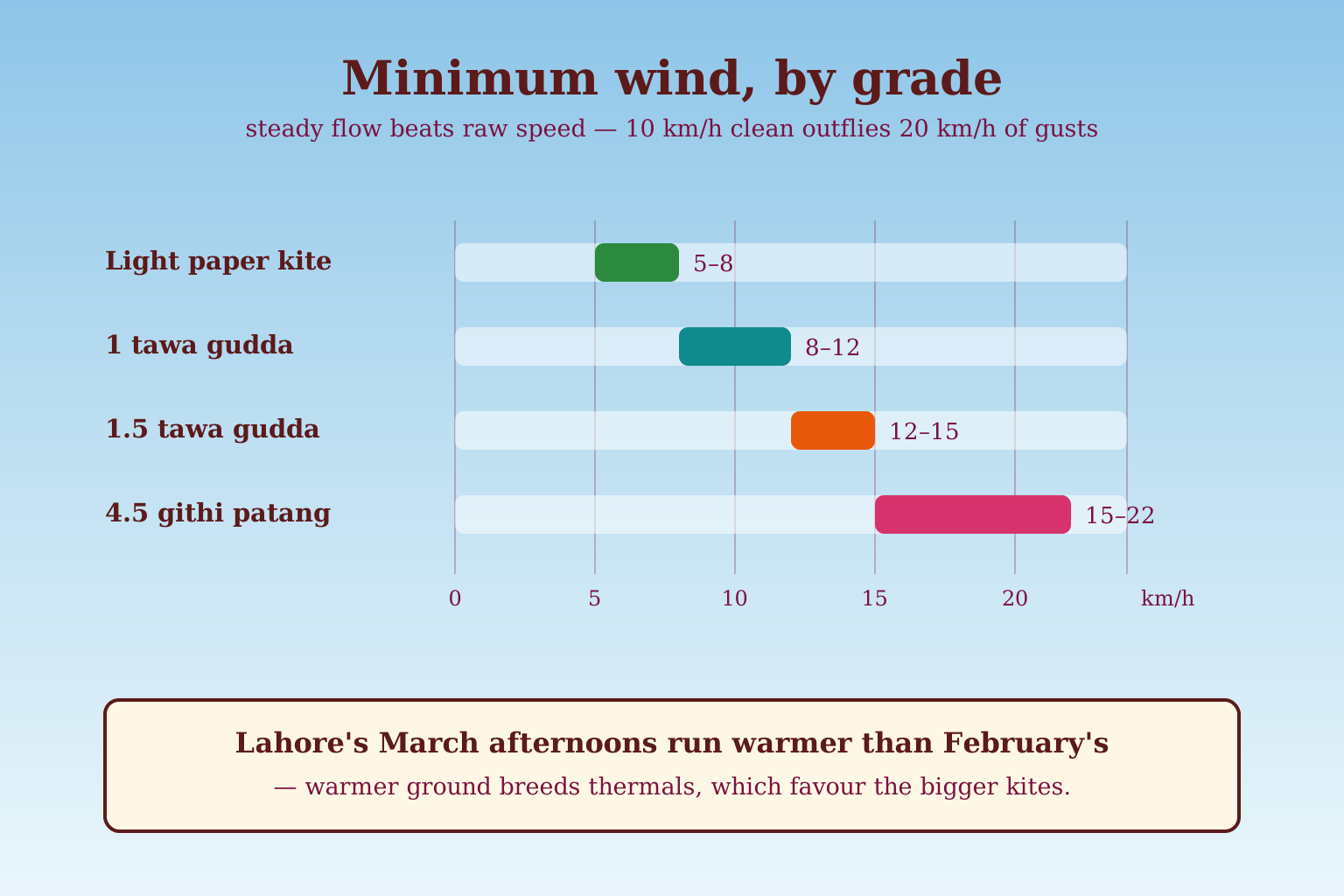
Light paper kites fly from roughly 5–8 km/h of steady breeze; a 1 tawa gudda wants 8–15 km/h; heavier grades — 1.5 tawa and serious githi patang — perform from the mid-teens upward. Lahore's festival months sit right in that band: February averages around 14–15 km/h winds with ~24°C highs, and March brings warmer afternoons whose thermal stirring favours the bigger kites — one quiet advantage of Basant 2027's 12–14 March dates.
- Minimums by class: light kites ~5–8 km/h · 1 tawa ~8–15 · 1.5 tawa and big patang mid-teens up
- Steadiness beats speed — 10 km/h of clean flow outflies 20 km/h of gusty swirl
- Read the roof, not the forecast: flags, height and the feel on your face are the real instruments
- Rooftop-level swirl is why launches fail; wind cleans up 50 feet above the parapet
- March afternoons in Lahore run warmer (~30°C) with livelier thermals than February's
"Can you fly a kite when it's not windy?" and "how much wind does a kite need?" are the same question from two moods — hope and doubt — and the answer is a table plus a skill. The table matches kite classes to wind speeds; the skill is reading what your particular rooftop is actually offering, which no city-wide forecast tells you. Here's both, tuned to Lahore's festival calendar, from a shop whose stock choices are wind decisions in disguise.
How much wind does each kite actually need?
The working minimums, assuming steady flow rather than gusts:
| Kite class | Comes alive at | Sweet spot |
|---|---|---|
| Light paper kites | ~5–8 km/h | gentle, steady breeze |
| 1 tawa gudda | ~8–12 km/h | ordinary rooftop days |
| 1.5 tawa gudda | ~12–15 km/h | wind with substance |
| 4.5 githi patang | mid-teens km/h+ | open sky, committed flow |
Below its minimum a kite doesn't fly badly — it simply won't sustain, and no technique compensates for air that isn't there. Above the sweet spot, pull climbs fast: a 1.5 tawa in 25 km/h is a workout, and a big patang in strong wind is the expert's kite the grades chapter warned about.
Can you fly when it's "not windy"?
Often, yes — because "not windy" at ground level and "flyable" at height are different facts. Street-level air is filtered through buildings; fifty feet above the parapet, flow that never reaches your face runs clean and steady. That's why the practiced move on a still-feeling day is a patient partner launch straight into a long climb — buy height fast, and let the upper air do the sustaining. (The launch mechanics live in the how-to-fly guide.)
The genuine no-fly day is rarer than it feels: air truly dead at height too, flags hanging vertical on every roofline in view. Then the kite that MIGHT still reward you is the lightest paper in the pile — and if that won't hold, the sky has spoken until the afternoon thermals arrive.
How do you read your rooftop without instruments?
Three checks, ten seconds:
- Flags and washing lines at YOUR height and above — stirring smoothly (light), streaming steadily (good), cracking and snapping (heavy). Ignore street-level cues entirely.
- Face and ears — felt clearly on the cheeks is roughly the 1 tawa threshold; enough to muss hair and hum faintly is 1.5-tawa air.
- Other kites — the festival's free telemetry. Steady neighbours at height = clean upper flow; everyone's kite wandering = gusty swirl, fly your forgiving grade.
Steadiness is the real reading. Gusty 20 km/h is harder work than smooth 10 — duels lost to a gust feel like bad luck but were really a forecast.
What will Basant 2027's March wind be like?
Statistically friendlier than February's, in an interesting way. Lahore's February runs average highs near 24°C with winds around 14–15 km/h; March lifts the highs toward 30°C, and those warmer afternoons generate thermal stirring — rising air that adds life to the flying hours even when the gradient wind is similar.
Practical translation for 12–14 March: expect afternoons that feed the 1.5 tawa and the patang a little more generously than the February revival did, mornings and nights that still favour the lighter fleet, and — as our February-vs-March weather deep-dive argues — a festival whose flying window sits closer to spring's sweet spot. Build the mixed fleet accordingly.
Frequently asked questions
What is the minimum wind speed to fly a kite?
Around 5–8 km/h of steady breeze for light kites; each grade up shifts the floor higher. Mid-teens km/h flies everything on our shelf.
Can you fly a kite with no wind at all?
Not sustainably — running generates only momentary lift. But truly zero wind at kite height is rare; a patient climb often finds air the street never feels.
Is too much wind bad for kites?
It's bad for learners and light frames — pull multiplies, paper stresses, and control windows shrink. Heavy grades exist precisely for those days, in experienced hands.
What time of day has the best kite wind?
Late morning through afternoon, once thermals wake — which is exactly the festival's traditional rhythm. Night sessions fly calmer air on lighter kites.
Which of your kites needs the least wind?
The 1 tawa gudda — the shelf's low-wind specialist and the reason it anchors every mixed fleet we recommend.
Match the fleet to the sky
Wind is the one festival variable nobody controls — so control the fleet instead: light grades for the quiet hours, muscle for the thermals. Reserve the mix now, free or price-locked, and whatever March serves, something in your pile will love it.
Written by M/S SpeedX Kites, a registered kite seller in Lahore (Reg No. 38731-28012026). If anything here is out of date or wrong, tell us on WhatsApp and we will correct it.
More on buying guides
Kite prices in Lahore: what patang, gudda and dor actually cost
Kite prices in Lahore move daily through Basant season. Gudda ran roughly Rs. 60–200 each at the 2026 festival and cotton pinna Rs. 4,000–12,000 a spool, depending on ply. Here is the reference table, and what we currently charge.
Tawa sizes explained: 1 tawa to 3 tawa, and which one you want
Tawa describes how much paper goes into a kite, running from 1 tawa upward. The bigger the grade, the more wind it needs and the harder it pulls. For an ordinary Lahore rooftop, 1 to 1.5 tawa is the comfortable range.