Gudda Kites: Grades, Designs and Honest Prices — the Buyer's Single Page
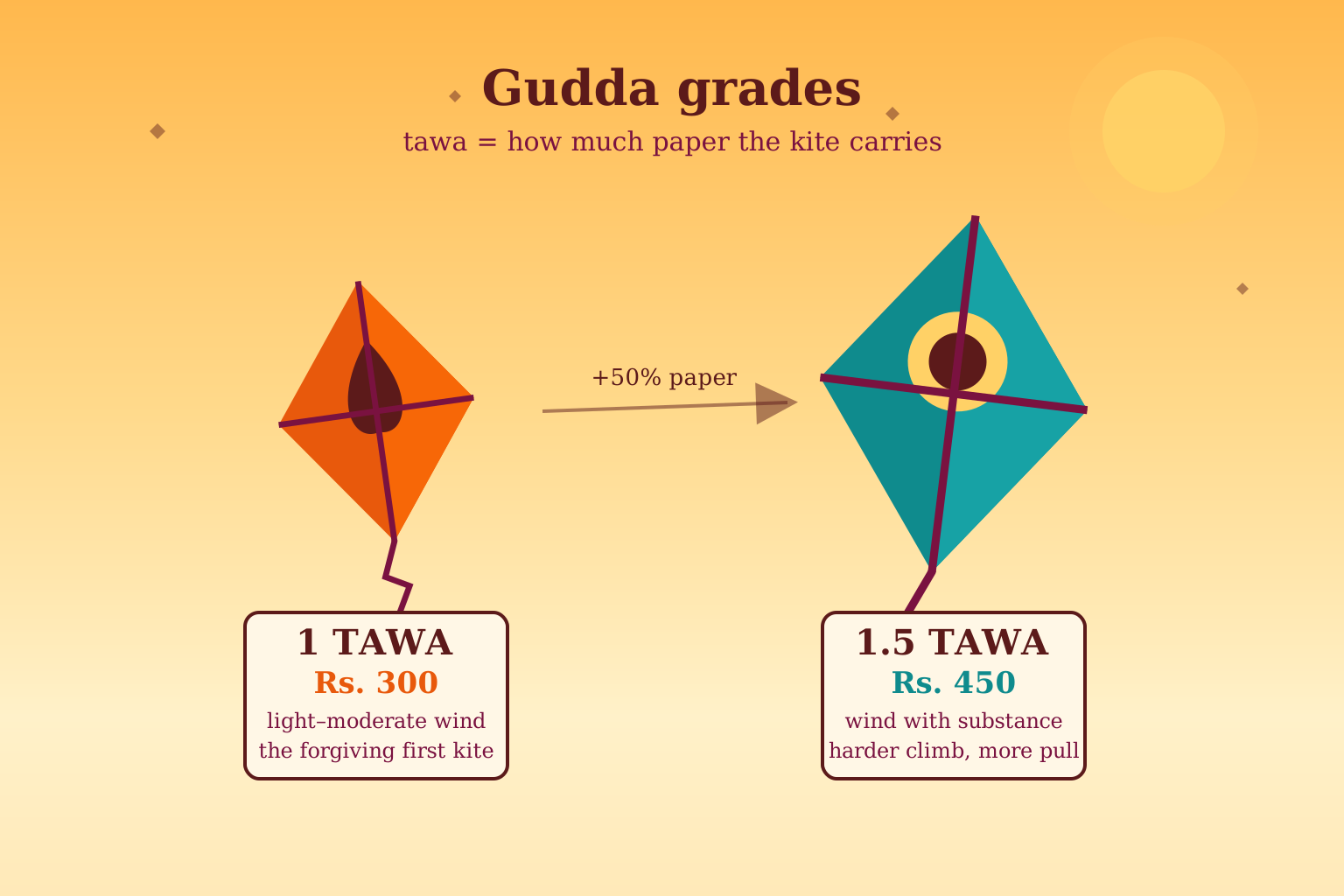
The gudda is the broad, steady workhorse kite of Lahore rooftops — easier to fly than a big patang, with real pull once the wind rises. It's graded by paper quantity in tawa: 1 tawa (Rs. 300 today) is the sensible first kite, 1.5 tawa (Rs. 450) the step up, and the Fancy (Rs. 650) is the same 1.5 frame wearing printed designs — taj circles, card suits — that stay recognisable at full line.
- Gudda = the stable, forgiving kite class; tawa = its paper-quantity grading
- 1 tawa suits ordinary walled rooftops and returning flyers; 1.5 wants wind with substance
- Fancy designs change visibility and identity, not flight — same size, same pull
- Today's rates: Rs. 300 / 450 / 650 single; dozens at exactly ×12
- 2026 market listings for comparable gudda ran Rs. 240–450 by grade
Every rooftop's kite pile is mostly gudda, and for good reason: it's the class that flies well for the most people in the most conditions. But "gudda kite" covers real choices — two grades, plain or decorated, singles or dozens — and the right picks depend on your roof, wind and flyers. This is the whole decision on one page, priced with today's dates on it, from the SpeedX Kites counter.
What is a gudda, and how is it different from a patang?
The gudda is the broader, rounder-shouldered kite — built for stability and pull rather than the patang's size and ceremony. In the air that means: easier launches, steadier holding in gusts, more forgiveness of a slack line — the reasons it's the class we hand first-timers and the class veterans still fly all day. (The full comparison lives in our gudda vs patang guide; the one-line version is *gudda for the day's flying, patang for the statement*.)
What do the tawa grades mean?
Tawa measures paper quantity — more tawa, more kite, more wind needed, more pull delivered:
- 1 tawa — the entry grade and honest default: comfortable on an ordinary walled rooftop in ordinary Lahore wind, forgiving while your hands remember the line. 2026-season market listings put 1 tawa gudda around Rs. 240–300.
- 1.5 tawa — half again the paper, and you feel it immediately: harder climbs, steadier duel-holding, gloves stop being optional. The grade most flyers settle on after a season back. Market comparables listed Rs. 400–450.
Grades above 1.5 exist in the wider market, but they trade rooftop-friendliness for demands most family roofs can't meet — our tawa sizes guide maps the whole ladder. We stock the two grades that fit the roofs we actually deliver to.
What makes a Fancy gudda "fancy"?
Printing, not flight. The Fancy is our 1.5 tawa frame wearing the classic Lahore decoration styles — bold taj (crown) circles, playing-card suits (spades, hearts, stars), strong two-colour blocking on white paper. Same size, same legal limits, same pull.
What the designs buy is recognition. At the end of a full pinna, against a bright crowded sky, a heavy dark motif on white is the kite you can still pick out as yours — which matters exactly when a duel starts. Designs rotate with stock, so we promise the style family rather than one exact print; tell us a preference at booking and we'll confirm what the week actually holds.
What do gudda cost right now?
Dated 28 August 2026, singles and dozens (a dozen gudda is a plain dozen — the raqam is patang vocabulary):
| Gudda | Single | Dozen (×12) |
|---|---|---|
| 1 Tawa | Rs. 300 | Rs. 3,600 |
| 1.5 Tawa | Rs. 450 | Rs. 5,400 |
| 1.5 Tawa Fancy | Rs. 650 | Rs. 7,800 |
The dozens exist because rooftops lose kites all day — cut lines, hard landings, walls — and a flying group without spares stops flying by mid-afternoon. Exact-multiple pricing is deliberate: this season's constraint is supply, and we'd rather say so than invent a discount. Rates are today's; reservations settle at delivery-day prices unless you lock with 50%.
Which gudda should your rooftop pre-book?
- First season back, or an enclosed courtyard roof: 1 tawa, a dozen between the household.
- Flew last season, roof catches clean wind: 1.5 tawa as the day's main kite.
- Duels and crowded skies: add Fancies — identity is tactical when six lines cross.
- Mixed group (the usual answer): a dozen 1 tawa as the fleet, a few 1.5s and Fancies as the sharp end.
Pair any of them with any of our 9-ply cotton pinna — every legal string flies every gudda we sell.
Frequently asked questions
What is a gudda kite in English?
There's no exact translation — it's the broad, stable class of Lahore fighter kite, distinct from the larger patang. The trade uses the Urdu names everywhere, and so do we.
Is 1 tawa or 1.5 tawa better for beginners?
1 tawa. It forgives light wind and loose hands; the 1.5 rewards a season's practice. Upgrading mid-festival is a joy — downgrading is a lesson.
Do Fancy kites fly differently?
No — printing adds no meaningful weight. Choose Fancy for visibility and identity, not performance.
How many gudda does a rooftop need?
A dozen per 4–5 casual flyers is the working minimum for a full day; duel-heavy roofs go higher. Spares are what keep the afternoon airborne.
Are these legal sizes?
Yes — both grades sit within the Ordinance caps and carry the QR sticker chain our verification guide walks through.
The workhorse, reserved and waiting
Pick the grade, count the dozen, add a Fancy for the duels — then book it all in two messages, free or price-locked. When the sale window opens, your gudda fleet arrives ready for the sky it was graded for.
Written by M/S SpeedX Kites, a registered kite seller in Lahore (Reg No. 38731-28012026). If anything here is out of date or wrong, tell us on WhatsApp and we will correct it.
More on buying guides
Kite prices in Lahore: what patang, gudda and dor actually cost
Kite prices in Lahore move daily through Basant season. Gudda ran roughly Rs. 60–200 each at the 2026 festival and cotton pinna Rs. 4,000–12,000 a spool, depending on ply. Here is the reference table, and what we currently charge.
Tawa sizes explained: 1 tawa to 3 tawa, and which one you want
Tawa describes how much paper goes into a kite, running from 1 tawa upward. The bigger the grade, the more wind it needs and the harder it pulls. For an ordinary Lahore rooftop, 1 to 1.5 tawa is the comfortable range.