The QR Sticker on a Legal Kite: What It Proves, How to Scan It, and What a Missing One Means
Every legal kite and ball of string in Punjab carries a government-issued QR sticker that scans to the official registration system and names the licensed manufacturer who made it. It's the festival's traceability backbone: one scan tells you the kite is lawful, sized within limits, and made in an approved district. A kite without a working sticker can't be verified, can be confiscated, and shouldn't be bought at any price.
- The QR sticker links each kite to its registered manufacturer via the official system
- Manufacturing is limited to four approved Punjab districts — the sticker is proof of that chain
- Scanning takes seconds with any phone camera
- In 2026, every legal pinna also had to carry the official sticker
- No sticker = no verification = confiscation risk and, for string, possible criminal exposure
The smallest thing on a legal kite is the most important: a sticker. The QR code system is what makes the revived festival auditable — the difference between "trust me, it's legal" and proof anyone can check in five seconds. As a registered seller whose entire stock lives inside this system, we get asked about the sticker constantly, so here's the complete picture: what it encodes, how to check it, and the buying situations where it should decide for you.
What does the QR sticker actually prove?
Three facts at once. First, origin: the code resolves to the registered manufacturer who produced the kite — and since only four Punjab districts are licensed to manufacture kite-flying material, a valid sticker places the kite inside that approved chain. Second, legality of type: registered production means legal sizes and materials. Third, accountability: if a batch is ever a problem, the sticker says exactly whose problem.
The system extends past kites: 2026's rules required that every legal pinna carry the official sticker too, making string — the festival's real risk item — traceable the same way.
How do you scan and check a kite's QR code?
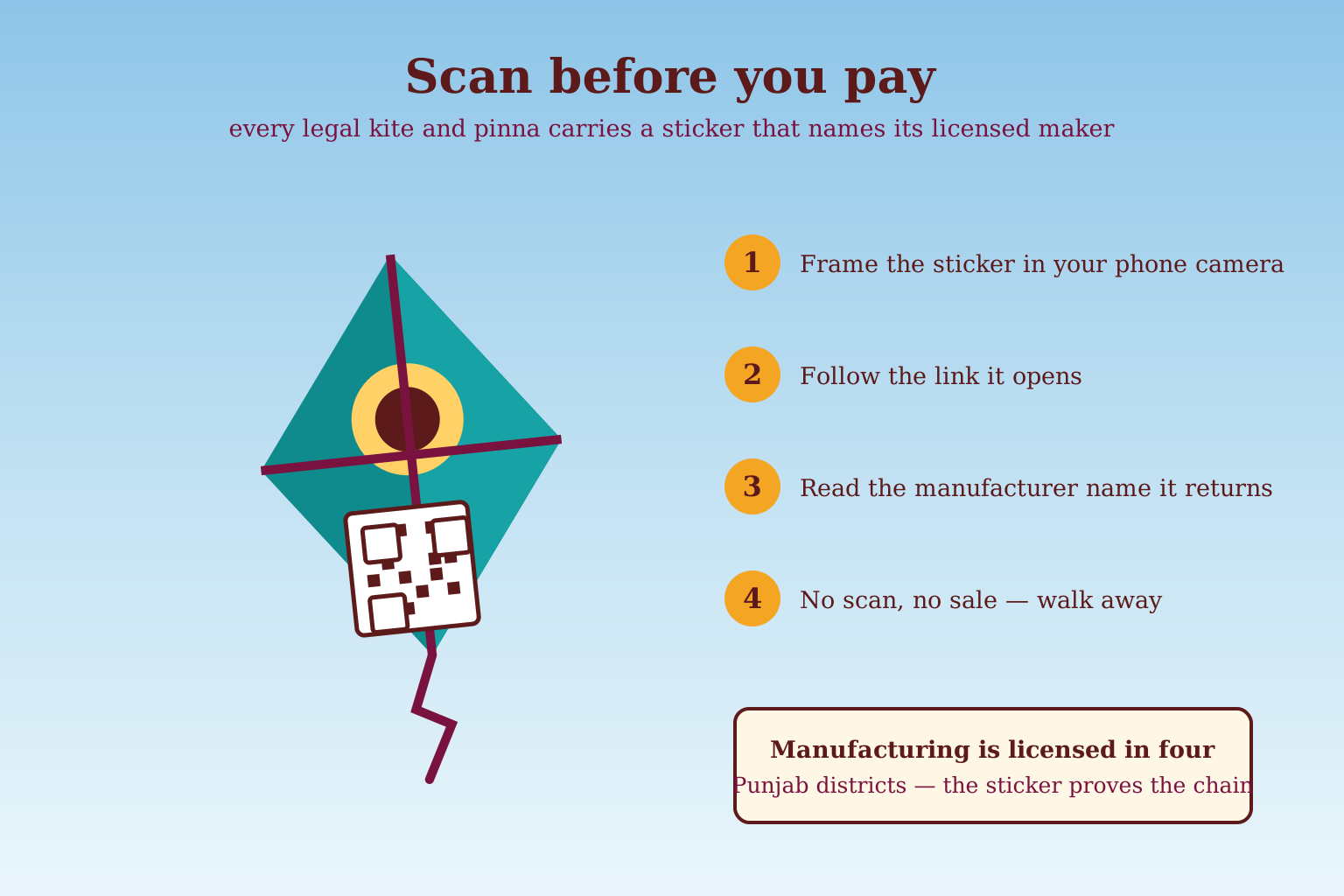
- Open your phone camera (or any QR app) and frame the sticker.
- Follow the link — it resolves into the official registration system used for the season (the 2026 cycle ran through the government's e-Biz/Basant portal infrastructure).
- Read the manufacturer name the code returns, and check it looks like a registered producer, not an error page.
- Match common sense: the sticker should be printed and affixed properly, not photocopied, taped-over or peeling off another surface.
That's the whole procedure. If a seller hesitates while you scan, you've learned what you needed anyway.
What does it mean if a kite has no sticker?
That nobody will vouch for it. An unstickered kite might be fine paper on fine bamboo — but it's outside the traceability chain, which means: it can't be shown legal, it can be confiscated at enforcement points, and it's disproportionately likely to have come with the other things the illegal chain sells, banned string first among them.
Price explains most missing stickers. Registration, verification and legal materials cost money; the "bargain" kite is usually cheap because it skipped exactly those steps. Our advice as a shop is blunt: the sticker IS the product — don't buy paper without it.
How does the sticker connect to seller registration?
It's the other half of the same system. Manufacturers register and sticker their production; sellers register separately and may only stock verified goods — unregistered sale was declared illegal outright in the 2026 cycle, with certificates displayed at premises. So a properly bought kite passes through two checkpoints: a licensed maker's sticker, and a registered seller's counter.
You can audit both in a minute: scan the kite, then ask to see the registration. Ours is Reg No. 38731-28012026, standing on the licence page with its limits stated plainly — and every kite and pinna we deliver arrives sticker-first, or it doesn't leave our stock.
Frequently asked questions
How do I verify a kite is legal in Lahore?
Scan its government QR sticker and confirm it resolves to a registered manufacturer, and buy from a seller who can show registration. Those two checks cover the law's whole chain.
Do kites need QR codes outside Basant?
The system operates around the permitted seasons — but legal stock is stickered at manufacture, so any legitimately produced kite carries one whenever you buy it.
Does string have a QR sticker too?
In the 2026 rules, yes — legal pinna required the official sticker. Treat unstickered string with double the suspicion you'd give a kite, because string is where the criminal penalties live.
Can a QR sticker be faked?
A printed square can be; the resolution can't — a fake code won't return a registered manufacturer from the official system. Scanning, not seeing, is the verification.
What happens if I'm caught with unverifiable kites?
Confiscation is the baseline risk. With banned string involved, exposure escalates sharply — up to five years and Rs. 2 million under the framework.
Buy the sticker, get the kite free
That's our honest framing of the whole system: what you're really paying a registered shop for is proof, and the kite comes with it. Our full stock — four kites, eight pinna names — lives inside the verification chain end to end. Reserve yours for March and scan everything we hand you; we built the business assuming you would.
Written by M/S SpeedX Kites, a registered kite seller in Lahore (Reg No. 38731-28012026). If anything here is out of date or wrong, tell us on WhatsApp and we will correct it.
More on rules & safety

Is kite flying legal in Pakistan right now? The province-by-province answer
It depends on the province and the date. In Punjab, kite flying is legal only during the government's announced festival window and under the 2025 Ordinance's conditions — outside that window it remains prohibited, including in Lahore. In Sindh, kite flying, manufacture and sale are banned outright. Status as of late August 2026: no flying window is open anywhere in Pakistan; the next announced window is Basant 2027, 12–14 March in Lahore.
Kite Flying Punishment in Pakistan: The Actual Fines and Jail Terms, Offence by Offence
The heaviest kite-related punishment in Pakistan targets banned string: making, selling or using metallic wire, nylon or chemical/glass-coated manjha carries three to five years' imprisonment, a fine up to Rs. 2 million, or both, under Punjab's 2025 Ordinance. Flying outside the announced window, selling without registration, and rooftop conduct violations are separate offences with their own consequences — and in Sindh, all kite flying is banned outright.