Patang Prices in Pakistan: Why the Big Kite Costs What It Costs
Patang pricing follows the making: more paper (higher githi), more bamboo work and a properly tensioned bow cost real craft hours, so a serious patang costs several times a small commodity kite. As of 28 August 2026 our 4.5 githi patang lists at Rs. 1,500 single or Rs. 18,000 for a raqam (the patang dozen), against 2026-season commodity patang at Rs. 800–900. Prices climb hardest in the season's final week.
- Patang cost = paper quantity (githi) + bamboo + the bow's craft hours
- A cheap large patang is a contradiction — big frames that fly demand real making
- The raqam (12 patang) prices at exactly 12× the single on an honest shelf
- 2026 reference points: small commodity patang Rs. 800–900; large-grade kites several times that
- The steepest price moves come late — early reservation is the whole strategy
Patang price questions usually hide a second question: why does the big kite cost five times the small one when they're both paper and bamboo? The answer is in the making, and once you see it, patang pricing stops looking arbitrary and starts predicting which kites will actually fly. Here's the cost anatomy, our dated rates as the worked example, and the one buying rule the trade lives by. We stock exactly one patang at SpeedX Kites — deliberately, and this page is the reasoning.
What actually drives a patang's price?
Three inputs, all physical:
- Paper — the githi grade. Githi measures how much paper the kite carries; a 4.5 githi patang is a lot of sky-facing surface, cut and seamed by hand. Paper is the visible cost.
- Bamboo. The spine and — critically — the bow must be straight-grained, matched and strong enough to hold a big frame's tension without warping. Good cane isn't the cheap part of the market.
- The bow's hours. This is the invisible cost that decides everything: a patang flies because its bow is tensioned true. A badly bowed big kite doesn't fly badly — it doesn't fly. Skilled making is what you're really buying.
That third input is why our patang product page says the price "reflects the paper and the hours in the bow, not a margin game" — and why the market's cheap big patang are the season's most disappointing purchases.
What do patang cost right now?
Dated 28 August 2026, from our shelf: Rs. 1,500 for the 4.5 githi patang single, Rs. 18,000 for a raqam — the patang trade's dozen, priced at exactly twelve singles because supply, not generosity, rules the season. (What a raqam is, and why gudda don't use the word, lives in our trade-units guide.)
For market context: 2026-season listings put small commodity patang around Rs. 800–900 each — fine kites for what they are, a different object from a large-grade patang. And the reference table in our kite prices guide tracks the broader 2026 ranges across classes.
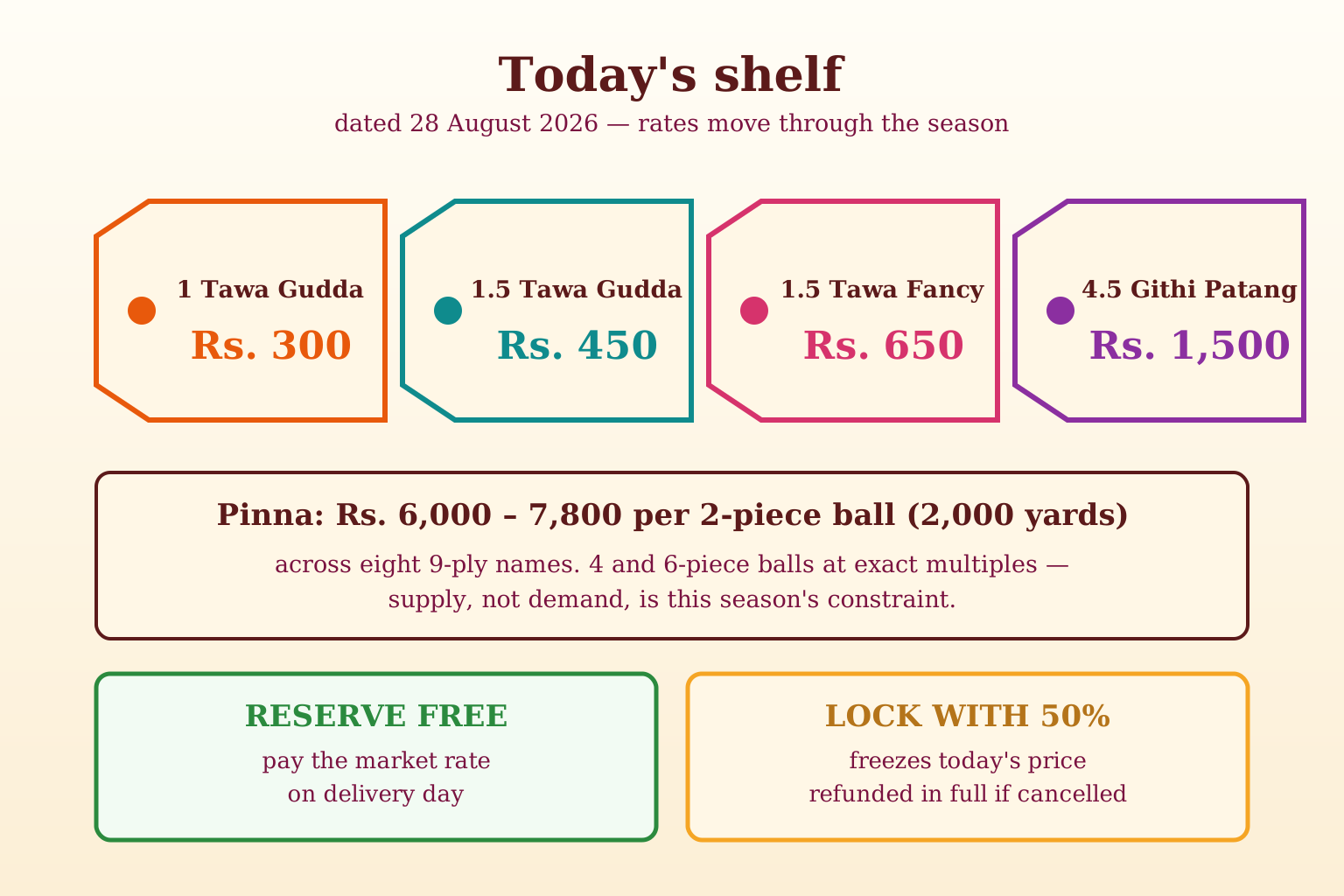
Every figure above is a today-rate: free reservations settle at delivery-day prices, while the 50% lock freezes the listed number whichever way the season moves.
Why do patang prices spike late in the season?
The same squeeze that empties every kite shelf, amplified by patang being the slowest kites to make. Manufacturing is confined to four licensed districts, the 2026 production window opened only weeks before the festival, and big kites consume the most maker-hours per unit — so large patang are the first category where demand outruns the possible supply. 2026 buyers who waited met the shortage everyone now remembers.
For 2027 the production permits are still pending, which makes the pattern's repeat the safe assumption — and the early reservation the only counter a buyer holds.
Is the big patang worth it for your rooftop?
Honest answer: only if your conditions match it. A 4.5 githi patang wants open sky, wind with substance and hands that have flown before; in light wind it underperforms a good gudda, and in strong wind it pulls hard enough to school a first-timer. The buying rule the trade lives by: match the kite to the roof and the flyer, then pay for quality in that size — never pay big-kite money for a frame your wind can't use.
If that's you, the raqam question is just arithmetic: rooftops that fly patang all day lose patang all day, and twelve at once beats twelve emergencies. If it isn't you yet, our gudda vs patang guide will likely save you money this season.
Frequently asked questions
How much is a patang in Pakistan?
Small commodity patang listed around Rs. 800–900 in the 2026 season; our large 4.5 githi patang is Rs. 1,500 today, Rs. 18,000 the raqam. Grade explains the gap.
What is a raqam of patang?
The patang dozen — twelve kites, the trade's bulk unit. On an honest shelf it costs exactly twelve singles.
Why are big patang so expensive?
Paper scales with githi, but the bow's craft hours scale faster — and a big kite with a bad bow is decoration. You're paying for the making that makes it fly.
When is patang cheapest?
Earliest. The season only moves one direction, and the final week is the historical peak. Locked-price reservations exist for exactly this curve.
Do you sell patang in dozens?
As raqams, yes — held under your name from reservation to the day sale opens legally.
Buy the kite the sky will respect
One patang, made properly, sized honestly, priced in daylight — that's the shelf. See it, reserve it, free or locked at today's rate, and let March find your bow already tensioned.
Written by M/S SpeedX Kites, a registered kite seller in Lahore (Reg No. 38731-28012026). If anything here is out of date or wrong, tell us on WhatsApp and we will correct it.
More on buying guides
Kite prices in Lahore: what patang, gudda and dor actually cost
Kite prices in Lahore move daily through Basant season. Gudda ran roughly Rs. 60–200 each at the 2026 festival and cotton pinna Rs. 4,000–12,000 a spool, depending on ply. Here is the reference table, and what we currently charge.
Tawa sizes explained: 1 tawa to 3 tawa, and which one you want
Tawa describes how much paper goes into a kite, running from 1 tawa upward. The bigger the grade, the more wind it needs and the harder it pulls. For an ordinary Lahore rooftop, 1 to 1.5 tawa is the comfortable range.