What Is a Raqam? Kite Trade Counting, From Singles to the Dozen
In the kite trade, a raqam is a dozen patang — twelve big kites, the unit serious buyers order in. The word belongs to patang specifically: gudda sell by the plain dozen, and string sells by the piece (1,000 yards) wound into pinna balls of 2, 4 or 6 pieces. Knowing these four units — raqam, dozen, piece, pinna — is the whole vocabulary of ordering correctly.
- Raqam = twelve patang; the word isn't used for gudda or string
- Gudda sell by the plain dozen — same twelve, different vocabulary
- String's unit is the piece (1,000 yards); the pinna is the wound ball holding 2/4/6 pieces
- Tawa and githi are sizing units, not quantities — they answer "how big", not "how many"
- On an honest shelf, every multi-unit is exact multiples: a raqam costs twelve singles
Every trade keeps a private counting language, and Lahore's kite trade kept a beautiful one through eighteen banned years. But private languages create ordering mistakes — a "raqam" heard as an amount of money, a "piece" assumed to be a ball — and those mistakes cost real rupees at festival prices. This is the counting page: every unit a kite conversation uses, defined by a seller who uses them across the counter daily.
What does raqam mean when buying kites?
Twelve patang. Walk into any kite shop in the city and ask for a raqam, and what you've ordered is a dozen of the big kites — the bulk unit for rooftops that fly patang seriously, because patang duels lose patang, and twelve at once beats twelve separate emergencies.
Two boundaries keep the word precise. First, it's patang vocabulary: the trade doesn't order a "raqam of gudda" — gudda move by the plain dozen (our gudda dozens are labelled exactly that). Second, don't let the everyday Urdu meaning of *raqam* — an amount, a sum of money — muddle the counter conversation; context does the work, but a written order ("1 raqam = 12 patang") does it better.
On pricing, the honest-shelf rule from our patang price guide applies: a raqam costs exactly twelve singles. Supply is this season's constraint, and invented "dozen discounts" usually hide a corner cut elsewhere.
How does string counting work — pieces and pinna?
Two units working together:
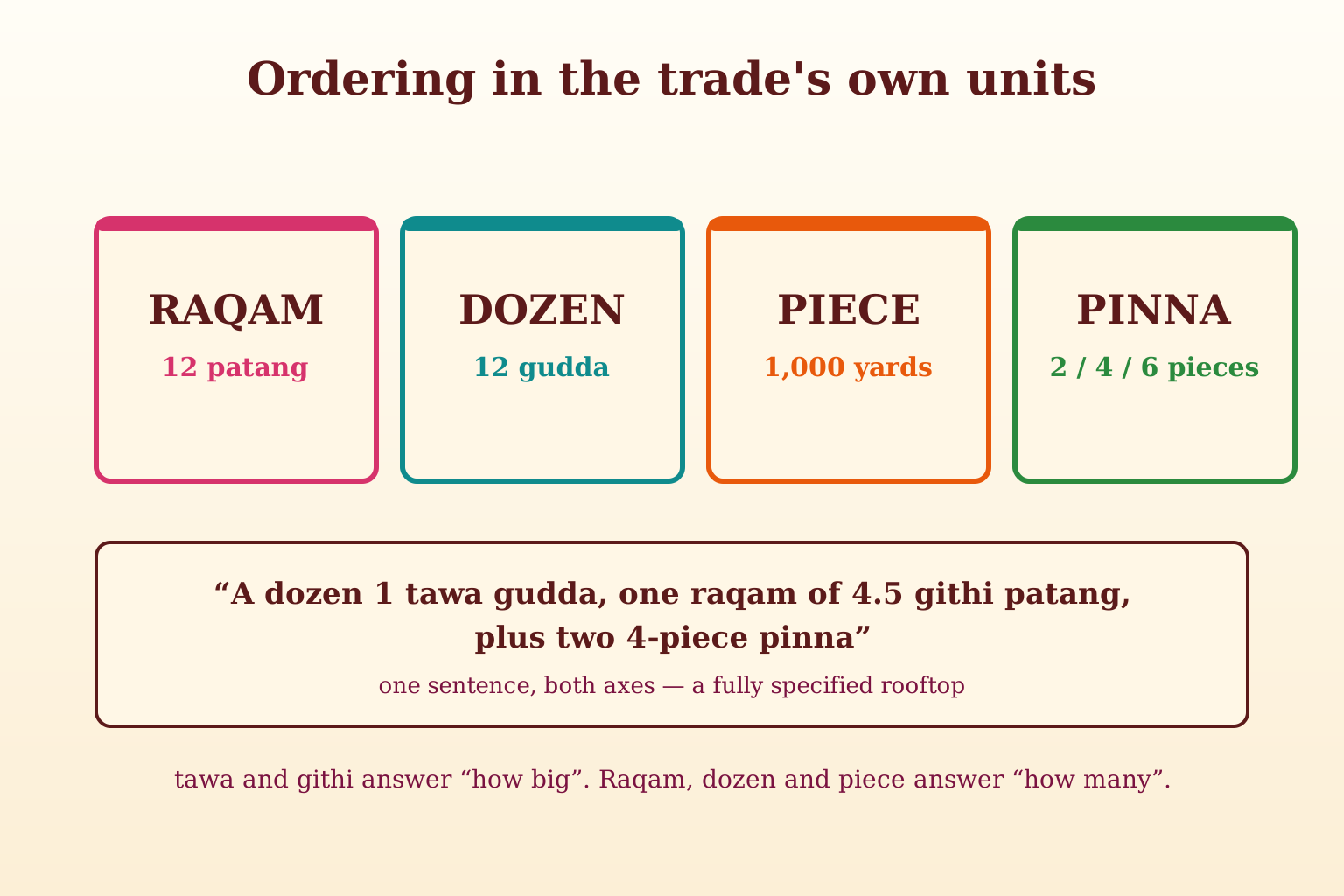
- The piece — the trade's atomic unit of string: 1,000 yards of thread.
- The pinna — the round wound ball you actually buy, holding 2, 4 or 6 pieces (2,000 / 4,000 / 6,000 yards).
So "a 4-piece pinna" is one ball containing four thousand yards. The distinction matters because dishonest quotes blur it — a cheap "ball" that's 2 pieces isn't cheaper than a fair 4-piece, it's smaller. Genuine manufacturer wrappers state yardage, and 2026's rules made the round pinna form part of the legal spec itself. Full pricing mechanics live in the dor price decoder; the ordering rule is simpler: piece count and yardage, in writing, every time.
Where do tawa and githi fit in?
Different axis entirely: those are sizing units, not quantities. Tawa grades a gudda's paper quantity, githi a patang's — they answer "how big is the kite", while raqam, dozen and piece answer "how many am I buying". A complete order uses both axes: *"a dozen 1 tawa gudda and one raqam of 4.5 githi patang, plus two 4-piece pinna"* is a fully specified rooftop in one sentence.
Both sizing systems have their own pages — tawa explained and githi explained — because both reward five minutes of fluency before festival money moves.
The whole counting system on one card
| Unit | What it counts | The number |
|---|---|---|
| Single | one kite | 1 |
| Dozen | gudda in bulk | 12 |
| Raqam | patang in bulk | 12 |
| Piece | string length | 1,000 yards |
| Pinna | the wound ball | 2, 4 or 6 pieces |
| Tawa | gudda size | grade, not quantity |
| Githi | patang size | grade, not quantity |
Order with that card and no counter in Lahore can confuse you — including ours, where the same units run the whole shop.
Frequently asked questions
What is a raqam of patang?
Twelve patang — the trade's dozen, specific to the big kites. It should price at exactly twelve singles.
Is raqam used for gudda too?
No — gudda sell by the plain dozen. Same count, different word, and shops keep the distinction.
How many yards in a pinna?
Depends on the piece count: 2 pieces = 2,000 yards, 4 = 4,000, 6 = 6,000. The piece (1,000 yards) is the constant.
Why does the kite trade use its own units?
Generations of practice — the units encode what buyers actually need (bulk kites, string by length, sizes by paper) more efficiently than metric ever did. The revival brought the vocabulary back with the festival.
Do I need to know these words to order from you?
No — plain language works fine on WhatsApp. But orders written in the trade's units are unambiguous, and unambiguous orders arrive exactly right.
Order like the trade does
One sentence, both axes, written down — that's expert-level kite buying, and it took one page. Put it to work: reserve your dozens, raqams and pieces now, free or price-locked, and March delivers precisely what you counted.
Written by M/S SpeedX Kites, a registered kite seller in Lahore (Reg No. 38731-28012026). If anything here is out of date or wrong, tell us on WhatsApp and we will correct it.
More on buying guides
Kite prices in Lahore: what patang, gudda and dor actually cost
Kite prices in Lahore move daily through Basant season. Gudda ran roughly Rs. 60–200 each at the 2026 festival and cotton pinna Rs. 4,000–12,000 a spool, depending on ply. Here is the reference table, and what we currently charge.
Tawa sizes explained: 1 tawa to 3 tawa, and which one you want
Tawa describes how much paper goes into a kite, running from 1 tawa upward. The bigger the grade, the more wind it needs and the harder it pulls. For an ordinary Lahore rooftop, 1 to 1.5 tawa is the comfortable range.