Kite String, Decoded: What 9-Ply Cotton Means and Why It's the Only Legal Choice
Legal kite string in Punjab is thread-based cotton — the 2026 specification allowed a maximum of 9 threads (9-tar), wound in round pinna balls. "Ply" (or cord/tar) counts the threads twisted together; "glace" describes the smooth polished finish of quality cotton lines; and the numbers in traditional string names — 8 Chain, 100 Escort, 35 Minar — are brand identity, not measurements. Everything coated, synthetic or metallic sits outside the law entirely.
- Ply/cord/tar = threads twisted into the line; 2026's legal max was 9-thread cotton
- "Glace" = the polished finish on quality mercerised cotton thread
- Name-numbers measure nothing: an 8 Chain isn't 8 of anything, a 100 Escort isn't 100 yards
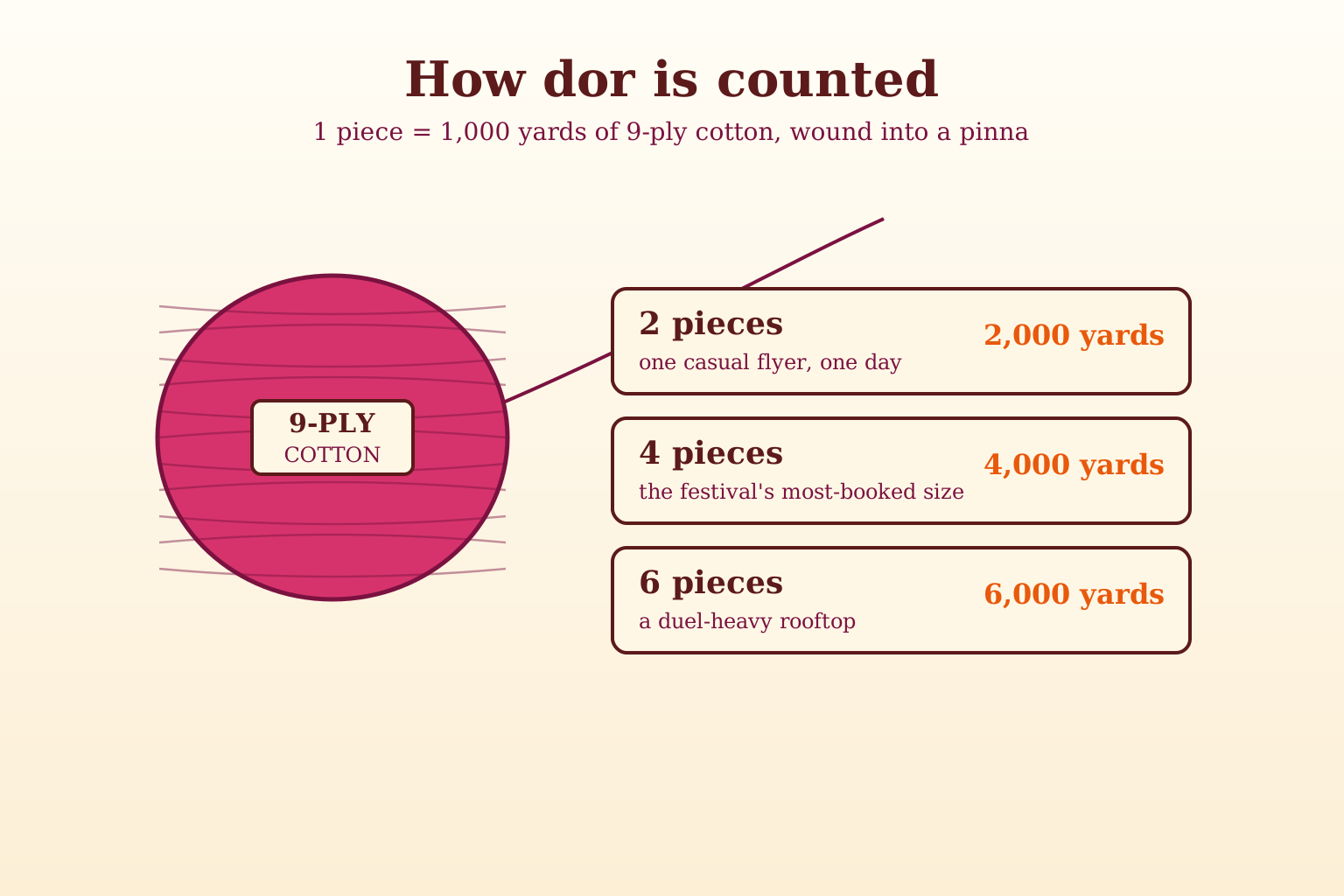
- The piece (1,000 yards) is the length unit; pinna balls carry 2, 4 or 6 pieces
- Legality is binary: uncoated cotton yes; chemical, glass, nylon, metallic — criminal
Kite string carries more confused vocabulary per metre than anything else in the festival: ply, tar, cord, glace, chain, pinna, pieces — plus name-numbers that sound like specifications and aren't. This is the decoder page. Ten minutes here and every string conversation in Lahore becomes legible, every quote comparable, and every illegal offer obvious. Written from the SpeedX Kites counter, where this vocabulary is the working day.
What does "ply" actually mean?
The thread count. Kite line is made by twisting fine cotton threads together; ply — the trade also says cord or, in Urdu, tar — counts how many. More threads, thicker and stronger line; fewer, lighter and subtler. The terms are interchangeable in practice: a genuine manufacturer's wrapper reads "9 cord glace cotton thread" where a shop would say 9-ply or 9-tar. Same fact, three dialects.
The law made the number binding: 2026's specification permitted 100% cotton thread to a maximum of nine threads — 9-tar — wound as pinna. That's why our whole shelf is 9-ply: it's the legal ceiling, and the festival standard.
What is "glace" cotton?
The finish. Glace (glazed) cotton is thread polished smooth in manufacture — mercerised, lustrous, running cleaner through fingers and air, holding tension more consistently than rough-spun line. It's a quality marker on genuine wrappers, not a coating: the polish is the cotton itself, worlds away from the applied abrasives that make chemical manjha criminal.
Rule of thumb at any counter: *glace describes how the cotton was finished; coated describes what was added afterward.* The first is the good word, the second is the police word.
Why don't the numbers in string names mean anything?
Because they're brand identity, inherited from thread-industry naming, and the trade kept them. The proof sits on the wrappers: a genuine "Chain 8" ball carries the number 8 beside the chain emblem while stating its actual specification separately — 9 cord cotton, yardage printed. The 8 is the name; the 9 is the spec; the yards are the yards.
So: 8 Chain isn't 8-ply, 100 Escort isn't 100 yards, 35 Minar and 25 Minar differ in name-standing rather than measurement, and Air Blade is a different product from "Air Blade 50" — a distinction that costs buyers real money when quotes blur it. What the names DO carry is reputation: seasons of rooftop standing that price the ladder from entry names to premium ones, all in the same legal cotton.
How is string measured and sold?
By the piece — 1,000 yards — wound into pinna balls of 2, 4 or 6 pieces (2,000–6,000 yards). The round pinna form was itself part of 2026's legal requirement, which is why legitimate string arrives as neat wound balls, yardage stated, rather than loose hanks. The full counting system — pieces, pinna, raqam and the rest — lives in the trade-units guide.
Ordering rule the decoder makes obvious: specify name + piece count ("4-piece 8 Chain") and any quote becomes checkable against any other.
Where exactly is the legal line?
Binary, with no near-misses:
Legal: thread-based, uncoated cotton within specification, QR-stickered under the traceability chain, from registered sellers. Our eight names all live here — the ladder prices reputation and winding, never construction.
Criminal: everything else. Chemical pastes, glass coatings, nylon, metallic wire — three to five years and up to Rs. 2 million, across making, selling and using. A line that promises to "cut everything" is quoting its own charge sheet.
Frequently asked questions
What is 9-ply kite string?
Line twisted from nine cotton threads — the 2026 legal maximum and the festival's standard grade. Also called 9-cord or 9-tar; identical meaning.
Is higher ply always better?
Heavier ply suits heavier kites and harder hands, but the legal ceiling settles the arms race — within it, choose by kite class and feel, not machismo.
What does glace mean on a string label?
Polished, mercerised cotton finish — a quality marker of genuine thread manufacture, not an additive coating.
Which kite string is strongest?
Among legal lines, strength tracks ply and winding quality, and every ball we sell sits at the 9-thread ceiling. Anything claiming strength beyond cotton's is describing an illegal line.
Why is kite string sold in yards?
Trade tradition backed by manufacturer labelling — wrappers print yardage, and the 1,000-yard piece is the universal unit. Metres convert easily; the counter just doesn't start there.
Fluent in string, ready for March
You can now read any wrapper, price any quote and spot any fake in the city — which makes the last step easy. The decoded shelf is here: eight honest names, one legal construction, reservable free or price-locked for the season ahead.
Written by M/S SpeedX Kites, a registered kite seller in Lahore (Reg No. 38731-28012026). If anything here is out of date or wrong, tell us on WhatsApp and we will correct it.
More on buying guides
Kite prices in Lahore: what patang, gudda and dor actually cost
Kite prices in Lahore move daily through Basant season. Gudda ran roughly Rs. 60–200 each at the 2026 festival and cotton pinna Rs. 4,000–12,000 a spool, depending on ply. Here is the reference table, and what we currently charge.
Tawa sizes explained: 1 tawa to 3 tawa, and which one you want
Tawa describes how much paper goes into a kite, running from 1 tawa upward. The bigger the grade, the more wind it needs and the harder it pulls. For an ordinary Lahore rooftop, 1 to 1.5 tawa is the comfortable range.