Chemical Manjha: What It Is, Why It's Banned, and How to Recognise It Before It's on a Roof
Chemical manjha is kite string treated with abrasive coatings — chemical pastes, powdered glass, or synthetic and metallic materials — to win cutting duels. It turns a festival line into a blade: it has cut throats, caused electrocutions, and is banned outright in Punjab, with three to five years' imprisonment and fines up to Rs. 2 million. The only legal kite string in Punjab is plain, uncoated, thread-based cotton.
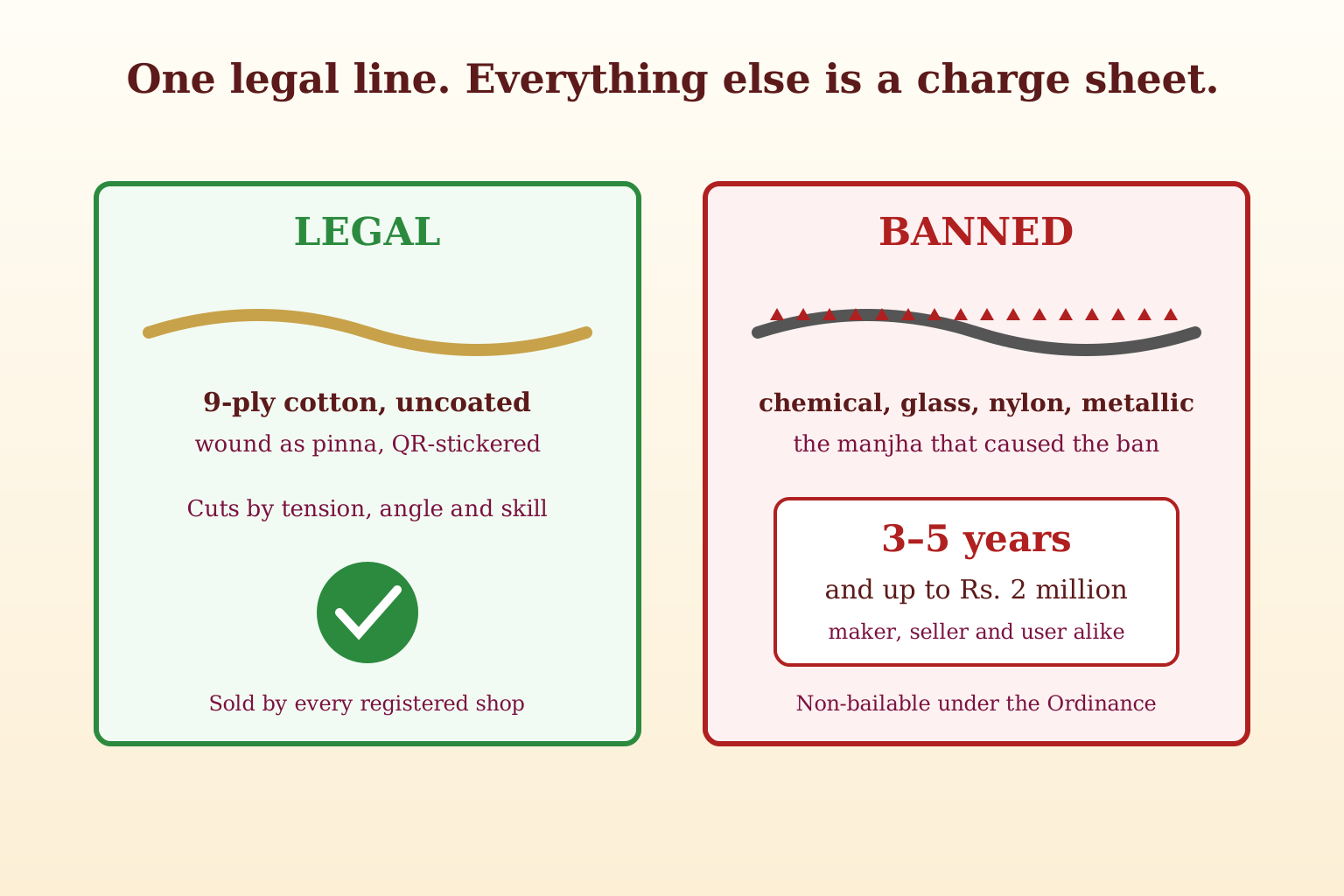
- "Chemical manjha" covers coated string generally: chemical pastes, glass powder, nylon, metallic wire
- These lines caused the deaths behind the 2007 ban and remain the festival's existential threat
- Penalties reach 3–5 years and Rs. 2 million, across makers, sellers and users
- Legal string is uncoated 9-ply cotton, wound as pinna, from registered sellers
- The spot-checks: feel, shine, stiffness, packaging and the seller's registration
We sell kite string for a living, and this is the page where we tell you which string never to buy — from us or anyone. Chemical manjha and its relatives are the reason Lahore's sky went silent for eighteen years, and they remain the one purchase that can end the revived festival for everyone. Here's what the banned lines actually are, why the law treats them as seriously as it does, and how to recognise them when someone offers you a "guaranteed winner".
What exactly is chemical manjha?
An arms race made of string. Traditional manjha was cotton line treated to cut better in duels; over time the treatments escalated — chemical pastes, finely crushed glass bonded to the thread, then factory-made synthetic lines and outright metallic wire. Each step cut opponents' kites better, and each step cut people worse.
The end state is a line that behaves like a saw under tension. Against a kite it wins duels; against a motorcyclist's throat at road height, or a power line over a rooftop, it kills — the documented cause of the deaths that brought the ban era.
Why is the punishment so heavy?
Because the law prices in the history. Under Punjab's framework, banned string — metallic wire, nylon and glass- or chemical-coated manjha — carries three to five years' imprisonment and fines up to Rs. 2 million, with the offence reported as non-bailable and the exposure covering the whole chain: manufacture, sale and use.
Nothing else in the kite framework comes close, and that's the point. The revival's political survival depends on coated string staying gone; the penalty is sized to that stake, as our punishment guide sets out alongside the other offences.
How do you recognise banned string?
Five checks, none requiring a lab:
- Feel (carefully). Legal cotton feels like soft thread. Coated line feels stiff, gritty or glassy — if drawing it lightly between fingers feels risky, that's the answer.
- Shine. Uncoated cotton is matte. A glinting, glazed or wire-bright line is treated or synthetic.
- Stiffness. Cotton drapes; coated and metallic lines hold shape or kink.
- The pitch. Any line sold on "cuts everything", "unbeatable", or "chemical" IS the confession.
- The seller. Registered shops with displayed certificates and QR-stickered stock have everything to lose by touching banned line; a roadside "special" has nothing to lose.
The legal standard is easy to remember because 2026's rules stated it plainly: only cotton thread within strict specifications, wound in round pinna form. Our own shelf carries eight names of exactly that — 9-ply uncoated cotton — and nothing else, on principle and on registration.
Doesn't cotton lose the duels?
Fair fights are the festival. When every rooftop flies cotton, cutting comes back to skill — line control, kite choice, wind reading — which is what bo kata meant for centuries before the coatings arrived. The flyer buying chemical line isn't buying skill; they're buying a criminal liability that also happens to endanger the neighbourhood.
And the legal shelf isn't one string: ply, finish and winding quality differ across the traditional names, which is why the trade still argues happily about which pinna to fly. The arguing is the healthy version of the arms race.
Frequently asked questions
Is all manjha illegal in Punjab?
Coated, treated, synthetic and metallic lines are illegal. Plain thread-based cotton string — pinna — is the legal category. If "manjha" means the coated stuff (as it usually does), then yes: banned.
What is the punishment for chemical manjha?
Three to five years' imprisonment, a fine up to Rs. 2 million, or both — for making, selling or using it.
Can chemical manjha really electrocute someone?
Metallic lines conduct; contact with power infrastructure has killed flyers and bystanders. It's one of the specific dangers named throughout the ban's history.
How do I report someone selling banned string?
Punjab police enforce the Ordinance — festival seasons run dedicated control rooms. Reporting protects the festival as much as the public.
Is imported "Indonesian" or branded coated line legal?
No. The ban is about what the line is, not where it's from — any coated, glass, nylon or metallic string falls under it.
The winning line is the legal one
Every ball of pinna we sell is the festival's insurance policy: uncoated cotton, traceable, honest about what it is. See the shelf, reserve what your rooftop needs, and let the duels of March be won the old way — on skill.
Written by M/S SpeedX Kites, a registered kite seller in Lahore (Reg No. 38731-28012026). If anything here is out of date or wrong, tell us on WhatsApp and we will correct it.
More on rules & safety
Is kite flying legal in Pakistan right now? The province-by-province answer
It depends on the province and the date. In Punjab, kite flying is legal only during the government's announced festival window and under the 2025 Ordinance's conditions — outside that window it remains prohibited, including in Lahore. In Sindh, kite flying, manufacture and sale are banned outright. Status as of late August 2026: no flying window is open anywhere in Pakistan; the next announced window is Basant 2027, 12–14 March in Lahore.
Kite Flying Punishment in Pakistan: The Actual Fines and Jail Terms, Offence by Offence
The heaviest kite-related punishment in Pakistan targets banned string: making, selling or using metallic wire, nylon or chemical/glass-coated manjha carries three to five years' imprisonment, a fine up to Rs. 2 million, or both, under Punjab's 2025 Ordinance. Flying outside the announced window, selling without registration, and rooftop conduct violations are separate offences with their own consequences — and in Sindh, all kite flying is banned outright.