First Aid on a Basant Rooftop: What the Rules Require, and What Sense Adds
The 2027 framework requires a first-aid kit on every premises hosting kite flying — and a useful one holds gauze, bandages, antiseptic, tape, scissors, burn dressing and any household medicines, positioned visibly on the roof. The judgment rule that matters more than the kit: line cuts and scrapes are roof-treatable; anything involving a fall, a head, or the street is a Rescue 1122 call first and first aid second.
- A first-aid kit on the hosting premises is a legal requirement for 2027, not a suggestion
- 2026's casualty pattern was falls-first — which is what your emergency thinking should be tuned to
- Roof-treatable: line cuts, scrapes, minor burns. Call-first: falls, head knocks, anything at street level
- Rescue 1122 saved in the host's phone, with the address rehearsed, is the kit's most important item
- The kit belongs visible and central — not under the food table when the moment comes
Of all the rooftop rules, the first-aid requirement is the one hosts tick mentally and skip physically — a kit "somewhere in the house" counted as compliance in 2026's excitement. This page makes it real: the exact kit worth assembling, where it lives on festival day, and the sixty-second triage judgment that the season's actual accident pattern demands. It completes our safety trilogy alongside the rooftop checklist and the string-injury guide — the unglamorous pages that keep the glamorous ones possible.
What does the law actually require?
The 2027 framework mandates first-aid availability at every premises hosting kite-flying activity, as part of the package that also makes hosts jointly liable for what happens on their roofs. The regulation names the requirement rather than an inventory — so the itemised kit below is our practical reading of "available and adequate," built from what festival days actually produce.
Legal box ticked honestly: a real kit, on the roof, known to the adults present. Thirty rupees of gauze in a drawer downstairs is not the requirement's spirit, and after the liability change, not its letter either.
What belongs in the rooftop kit?
The festival-tuned inventory:
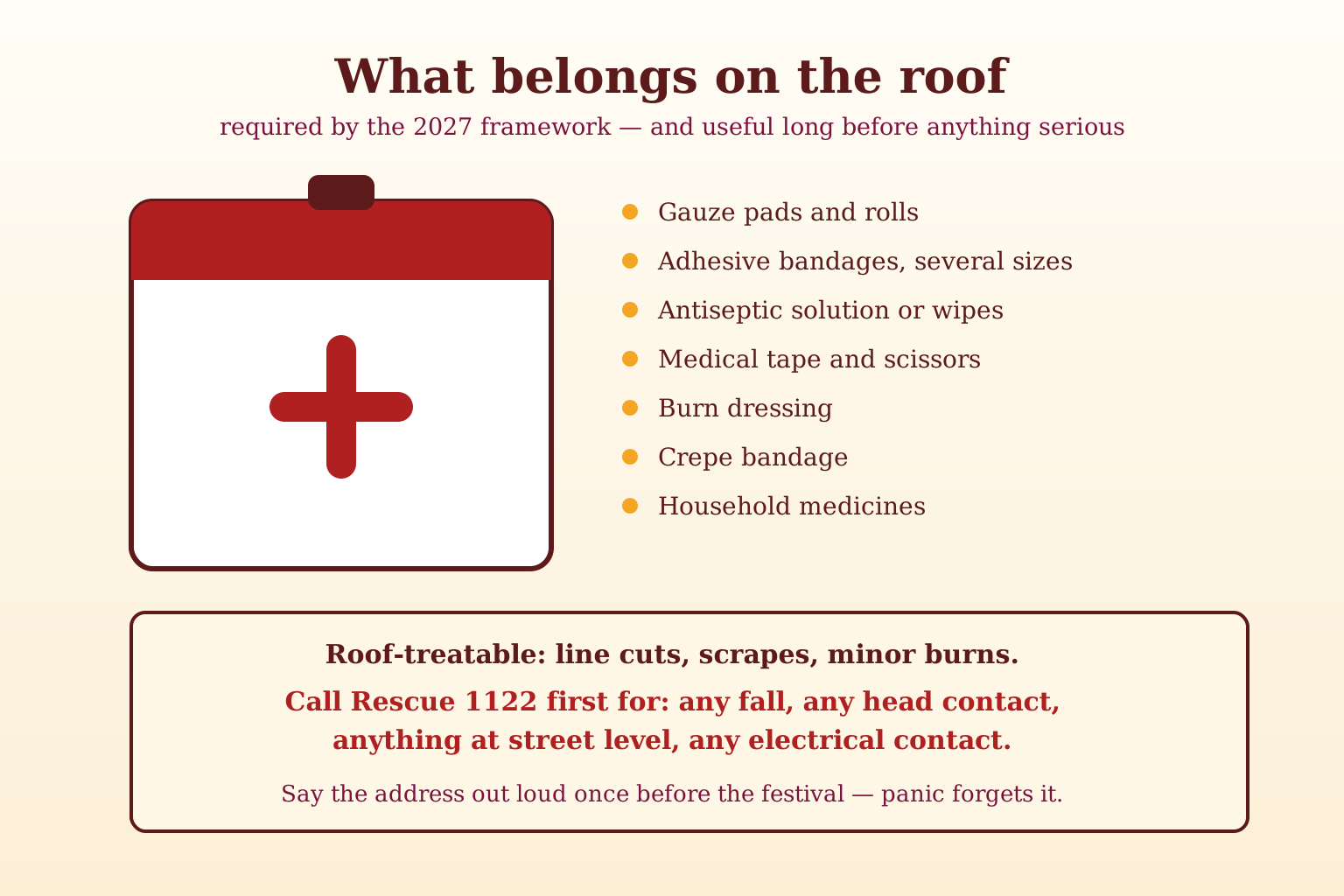
- Gauze pads and rolls — line cuts and scraped knuckles are the day's routine trade
- Adhesive bandages, several sizes — for the fingers that clamped a running line
- Antiseptic solution or wipes — every open cut, before dressing
- Medical tape and scissors — dressings that survive a flyer going straight back to the charkhi
- Burn dressing — friction burns from line, plus the rooftop barbecue's contributions
- Crepe bandage — sprains from the stairs and the excited footwork the rules ban for good reason
- Household regulars — paracetamol, any personal medicines the group's elders need on hand
- The paper item: Rescue 1122 and the roof's street address written on the kit's lid — because phones die and panic forgets
Position it visibly at the rooftop's calm edge — with the water, away from the flying line's traffic — and tell every adult where it is when the day starts. That sentence costs five seconds and is most of the requirement's real value.
When do you treat on the roof, and when do you call?
The judgment that matters, tuned to what 2026 actually recorded — a casualty pattern led overwhelmingly by falls, not string:
Roof-treatable: line cuts to hands, scrapes, minor burns, small sprains. Clean, dress, rest the flyer an hour — the kit's daily work.
Call Rescue 1122 first, aid second:
- Any fall — from any height, however the person insists they're fine; falls are the season's killer and adrenaline is a liar
- Any head contact — with parapet, floor or flying debris
- Anything at street level — a line incident involving a rider or passer-by is an emergency and a reportable illegal-string signal in one
- Electrical contact of any kind — kite, line or person against wiring: nobody touches anything until the call is made
The call script panic needs pre-loaded: *location first, then what happened, then how many hurt.* Saying the address aloud once before the festival is the cheapest rehearsal in emergency medicine.
Frequently asked questions
Is a first-aid kit legally required for Basant?
Yes — the 2027 rooftop framework requires first-aid availability at hosting premises, effective ahead of the March festival.
What is Rescue 1122?
Punjab's emergency rescue service — the festival's designated emergency number, and the first call for falls, head injuries or street-level incidents.
Can I treat a kite string cut at home?
Hand cuts from legal cotton, yes: pressure, clean, antiseptic, dress. Deep cuts across joints or anything that won't close cleanly deserve a clinic same-day.
What's the most likely injury at a rooftop party?
Minor hand cuts and scrapes by count — falls by consequence. Stock the kit for the first; build your rooftop discipline for the second.
Where should the kit be on festival day?
Visible, central, announced — the calm corner with the water. A kit nobody can find is a drawer, not a kit.
The least festive page, for the most festive reason
Nobody remembers the kit from a good Basant — which is exactly the goal. Assemble it this week, announce it on the day, rehearse the address once, and give the festival's odds their final nudge. The joyful half of preparation is waiting too: kites and pinna, reservable now, for the three days all this care is in service of.
Written by M/S SpeedX Kites, a registered kite seller in Lahore (Reg No. 38731-28012026). If anything here is out of date or wrong, tell us on WhatsApp and we will correct it.
More on rules & safety
Is kite flying legal in Pakistan right now? The province-by-province answer
It depends on the province and the date. In Punjab, kite flying is legal only during the government's announced festival window and under the 2025 Ordinance's conditions — outside that window it remains prohibited, including in Lahore. In Sindh, kite flying, manufacture and sale are banned outright. Status as of late August 2026: no flying window is open anywhere in Pakistan; the next announced window is Basant 2027, 12–14 March in Lahore.
Kite Flying Punishment in Pakistan: The Actual Fines and Jail Terms, Offence by Offence
The heaviest kite-related punishment in Pakistan targets banned string: making, selling or using metallic wire, nylon or chemical/glass-coated manjha carries three to five years' imprisonment, a fine up to Rs. 2 million, or both, under Punjab's 2025 Ordinance. Flying outside the announced window, selling without registration, and rooftop conduct violations are separate offences with their own consequences — and in Sindh, all kite flying is banned outright.