How Much Dor Do You Need for One Day of Basant? The Consumption Math Nobody Publishes
Plan around 2 pieces (2,000 yards) of cotton dor per casual flyer for a full Basant day, and 4 pieces for anyone flying duels aggressively — every lost pecha costs the line that went with the kite. A typical 4-flyer family rooftop lands at 8–12 pieces for the festival's main day; a 10–12 person duel-heavy roof can burn 30 pieces and be glad it bought them.
- Baseline: ~2 pieces per casual flyer per full day; ~4 for aggressive duellists
- Cuts are the multiplier — you lose line in every defeat, and sometimes in victory
- One ball on the roof is a problem: parallel charkhis keep the flying continuous
- Three festival days ≠ 3× one day; days two and three run lighter for most groups
- Under-buying costs more than over-buying: mid-festival dor is the season's most expensive
Every rooftop asks this question exactly once — usually at 11am on the festival's first day, holding an empty charkhi. How much dor you need isn't mystical; it's arithmetic driven by two numbers (flyers and flying style) and one multiplier (how many duels you lose). Here's the worksheet, from a shop that spends the season hearing which estimates survived contact with the sky. It pairs with our dor price guide — this page is *how many pieces*, that one is *what they cost*.
Why does kite flying consume so much line?
Because line, unlike kites, disappears in chunks. Three drains run all day:
- Cuts. Lose a pecha and everything past the cut point goes with the kite — often several hundred yards in one moment.
- Damage. Cotton frays at rub points and tangles cost usable length even when untangled.
- Working length. A high, steady kite holds 400–800 yards aloft continuously; you can't fly nine kites off one 2,000-yard ball even with zero losses.
That first drain dominates. A flyer who avoids duels can nurse 2 pieces all day; a flyer hunting bo kata converts line into glory at a rate that surprises first-timers.
The worksheet: pieces by rooftop
Baseline assumptions: full main-day flying, legal 9-ply cotton in 1,000-yard pieces, a mix of gudda and patang.
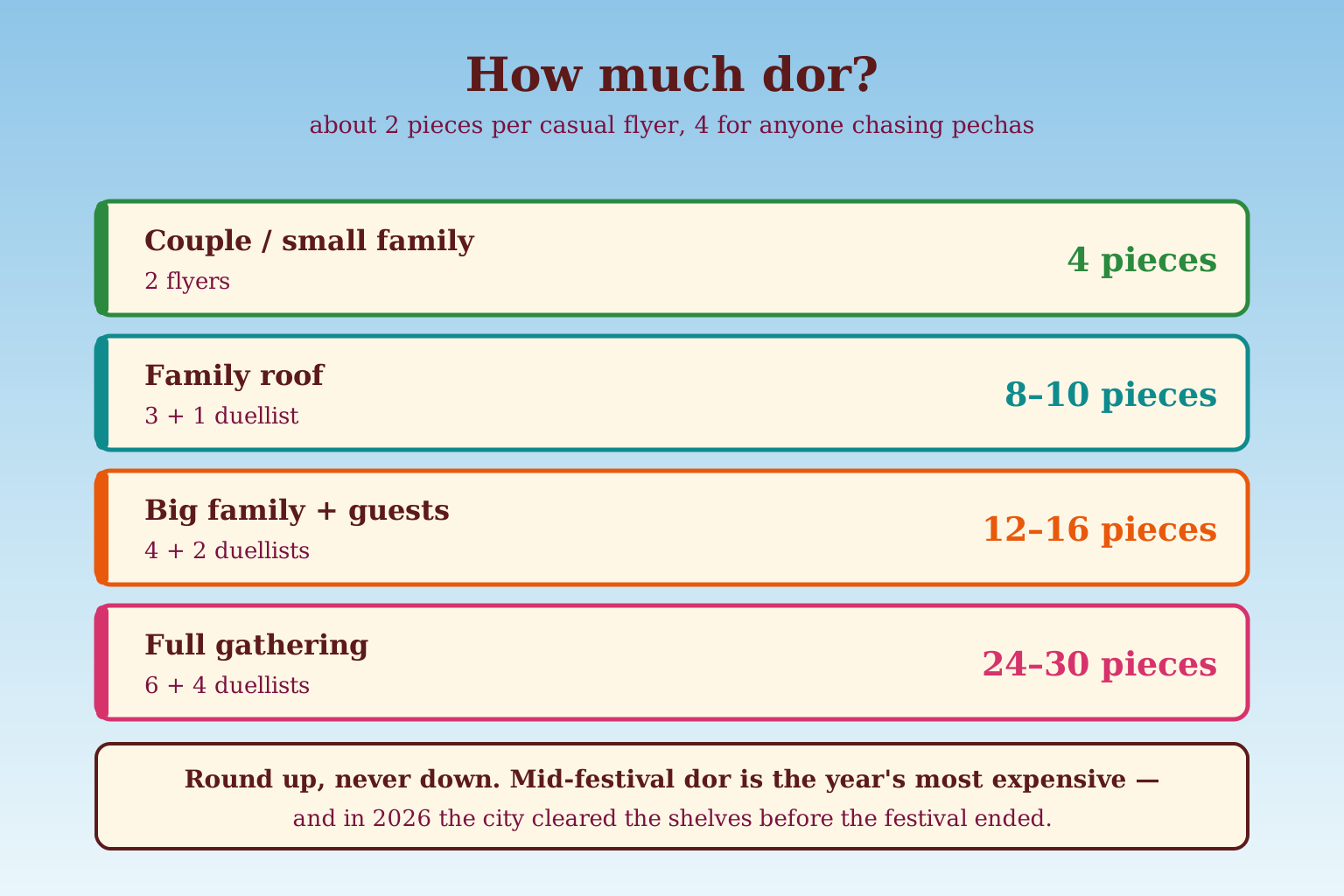
| Rooftop | Casual flyers | Duellists | Suggested pieces |
|---|---|---|---|
| Couple / small family | 2 | 0 | 4 |
| Family roof | 3 | 1 | 8–10 |
| Big family + guests | 4 | 2 | 12–16 |
| Full gathering | 6 | 4 | 24–30 |
Round up, not down, for three reasons: spare line rescues a good day (a fresh ball mid-afternoon keeps the roof flying), leftover cotton keeps perfectly for the next window, and the alternative — buying mid-festival — means the week's worst prices *if* stock exists. In 2026's one-week retail window, the city cleared shelves before the festival ended.
Does three festival days mean three times the dor?
No — plan the main day fully and scale the rest. Most rooftops fly hardest on one headline day (2026's middle Saturday was the peak), with lighter sessions either side. A working rule: main day at full worksheet rate, plus 50–60% of that total to cover the other two days. The 4-flyer roof planning 10 main-day pieces books 16 for the festival and comes home right.
Night sessions consume less than daytime duels — fewer crossings, steadier flying — but they still eat working length, so the white-kite hours aren't free.
How should the pieces be split across balls?
Favor more balls over bigger ones, up to a point. Two flyers sharing one 6-piece ball take turns; two flyers with a 2-piece and a 4-piece fly simultaneously. Parallel charkhis are what keep a rooftop's sky continuously occupied — and a cut becomes a two-minute reload instead of a queue.
Mixing names works fine too: many groups run a premium ball (8 Chain or Air Blade) for the serious duellist and entry-name balls for everyone else. Same legal cotton throughout; the split is about feel and budget, not legality.
Frequently asked questions
How much dor does one kite use?
Flying uses 400–800 yards of working length at a time; losing the kite in a duel forfeits whatever was out. It's the losses, not the flying, that set consumption.
Is 2,000 yards enough for Basant?
For one casual flyer's day, usually yes. For a duellist or a shared family ball, it runs out — which is why the 4-piece is the festival's most-booked size on our shelf.
Can leftover dor be used next year?
Cotton stores well kept dry and wound — leftover legal pinna is next season's head start, not waste.
Should I buy dor before kites?
Book them together; rooftops underestimate string far more often than kites. Our pre-booking holds both under one name with no payment needed.
What if we run out mid-festival?
You join the most expensive queue of the year. The whole point of the worksheet is never meeting it.
Do the math once, fly all day
Count your flyers, tag your duellists, read the table, round up — done. Then reserve the pieces free or price-locked, and spend the festival watching the sky instead of the supply.
Written by M/S SpeedX Kites, a registered kite seller in Lahore (Reg No. 38731-28012026). If anything here is out of date or wrong, tell us on WhatsApp and we will correct it.
More on buying guides
Kite prices in Lahore: what patang, gudda and dor actually cost
Kite prices in Lahore move daily through Basant season. Gudda ran roughly Rs. 60–200 each at the 2026 festival and cotton pinna Rs. 4,000–12,000 a spool, depending on ply. Here is the reference table, and what we currently charge.
Tawa sizes explained: 1 tawa to 3 tawa, and which one you want
Tawa describes how much paper goes into a kite, running from 1 tawa upward. The bigger the grade, the more wind it needs and the harder it pulls. For an ordinary Lahore rooftop, 1 to 1.5 tawa is the comfortable range.